If All Humans Died Would Humans Evolve Again
READER QUESTION: If humans don't die out in a climate apocalypse or asteroid touch in the next 10,000 years, are we probable to evolve further into a more advanced species than what we are at the moment? Harry Bonas, 57, Nigeria
Humanity is the unlikely result of 4 billion years of evolution.
From cocky-replicating molecules in Archean seas, to eyeless fish in the Cambrian deep, to mammals scurrying from dinosaurs in the night, and so, finally, improbably, ourselves – evolution shaped us.
Organisms reproduced imperfectly. Mistakes made when copying genes sometimes made them better fit to their environments, so those genes tended to become passed on. More reproduction followed, and more mistakes, the process repeating over billions of generations. Finally, Human being sapiens appeared. But we aren't the end of that story. Evolution won't terminate with u.s.a., and we might even be evolving faster than always.
This article is part of Life's Big Questions
The Conversation's new serial, co-published with BBC Time to come, seeks to reply our readers' nagging questions about life, dearest, death and the universe. We piece of work with professional researchers who have defended their lives to uncovering new perspectives on the questions that shape our lives.
It'southward hard to predict the future. The world volition probably change in ways we can't imagine. But nosotros can brand educated guesses. Paradoxically, the best way to predict the future is probably looking dorsum at the by, and assuming past trends will go along going forward. This suggests some surprising things about our hereafter.
We will likely live longer and go taller, every bit well as more lightly built. We'll probably be less ambitious and more agreeable, but have smaller brains. A bit like a gilded retriever, nosotros'll be friendly and jolly, just peradventure non that interesting. At least, that's 1 possible futurity. But to understand why I remember that's likely, we need to look at biology.
The end of natural pick?
Some scientists have argued that civilisation's rise ended natural pick. It's true that selective pressures that dominated in the past – predators, famine, plague, warfare – accept generally disappeared.
Starvation and famine were largely ended by high-yield crops, fertilisers and family planning. Violence and war are less common than ever, despite modernistic militaries with nuclear weapons, or maybe because of them. The lions, wolves and sabertoothed cats that hunted usa in the nighttime are endangered or extinct. Plagues that killed millions – smallpox, Black Expiry, cholera – were tamed past vaccines, antibiotics, clean water.
But evolution didn't stop; other things just bulldoze it now. Evolution isn't then much about survival of the fittest every bit reproduction of the fittest. Even if nature is less likely to murder united states, we still need to notice partners and enhance children, so sexual selection now plays a bigger function in our evolution.
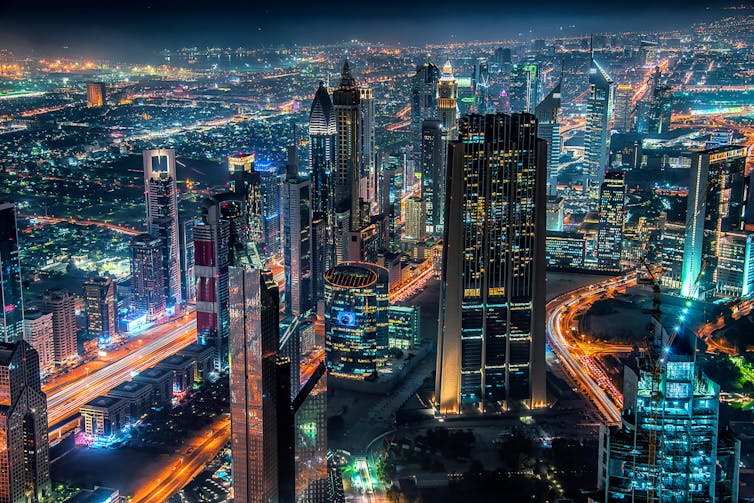
And if nature doesn't control our evolution anymore, the unnatural surroundings nosotros've created – culture, technology, cities – produces new selective pressures very different those nosotros faced in the ice age. We're poorly adapted to this modern world; information technology follows that we'll take to accommodate.
And that process has already started. As our diets changed to include grains and dairy, we evolved genes to assistance us assimilate starch and milk. When dense cities created conditions for affliction to spread, mutations for affliction resistance spread too. And for some reason, our brains have got smaller. Unnatural environments create unnatural choice.
To predict where this goes, we'll wait at our prehistory, studying trends over the past half-dozen million years of evolution. Some trends will continue, especially those that emerged in the past 10,000 years, subsequently agriculture and civilisation were invented.
We're too facing new selective pressures, such equally reduced mortality. Studying the past doesn't help here, only we tin can see how other species responded to similar pressures. Evolution in domestic animals may be especially relevant – arguably we're becoming a kind of domesticated ape, but curiously, 1 domesticated by ourselves.
I'll utilize this approach to make some predictions, if not always with high confidence. That is, I'll speculate.
Lifespan
Humans volition almost certainly evolve to live longer – much longer. Life cycles evolve in response to mortality rates, how likely predators and other threats are to impale y'all. When mortality rates are high, animals must reproduce young, or might not reproduce at all. At that place's also no reward to evolving mutations that forbid ageing or cancer - y'all won't alive long plenty to employ them.
When bloodshed rates are low, the reverse is true. It'southward meliorate to take your time reaching sexual maturity. Information technology'due south likewise useful to have adaptations that extend lifespan, and fertility, giving you more than time to reproduce. That's why animals with few predators - animals that alive on islands or in the deep body of water, or are merely big - evolve longer lifespans. Greenland sharks, Galapagos tortoises and bowhead whales mature late, and tin can live for centuries.
Fifty-fifty before civilisation, people were unique among apes in having low mortality and long lives. Hunter-gatherers armed with spears and bows could defend against predators; food sharing prevented starvation. So we evolved delayed sexual maturity, and long lifespans - up to seventy years.
Still, child bloodshed was high - budgeted 50% or more than by historic period 15. Average life expectancy was simply 35 years. Even after the ascent of civilisation, child mortality stayed high until the 19th century, while life expectancy went down - to thirty years - due to plagues and famines.
Then, in the past 2 centuries, better nutrition, medicine and hygiene reduced youth mortality to under 1% in most developed nations. Life expectancy soared to 70 years worldwide , and fourscore in developed countries. These increases are due to improved health, not evolution – but they set the phase for evolution to extend our lifespan.
Now, at that place's fiddling need to reproduce early on. If anything, the years of training needed to be a physician, CEO, or carpenter incentivise putting it off. And since our life expectancy has doubled, adaptations to prolong lifespan and child-bearing years are now advantageous. Given that more and more people live to 100 or even 110 years - the tape being 122 years - in that location's reason to think our genes could evolve until the average person routinely lives 100 years or even more.
Size, and strength
Animals often evolve larger size over time; it's a trend seen in tyrannosaurs, whales, horses and primates - including hominins.
Early hominins like Australopithecus afarensis and Homo habilis were pocket-size, four to five feet (120cm-150cm) tall. Later hominins - Homo erectus, Neanderthals, Homo sapiens - grew taller. We've continued to gain acme in historic times, partly driven by improved nutrition, but genes seem to be evolving too.
Why we got big is unclear. In function, bloodshed may drive size evolution; growth takes time, so longer lives hateful more than fourth dimension to grow. But human females also adopt tall males. And then both lower mortality and sexual preferences will likely crusade humans to get taller. Today, the tallest people in the world are in Europe, led by holland. Here, men boilerplate 183cm (6ft); women 170cm (5ft 6in). Someday, most people might be that tall, or taller.
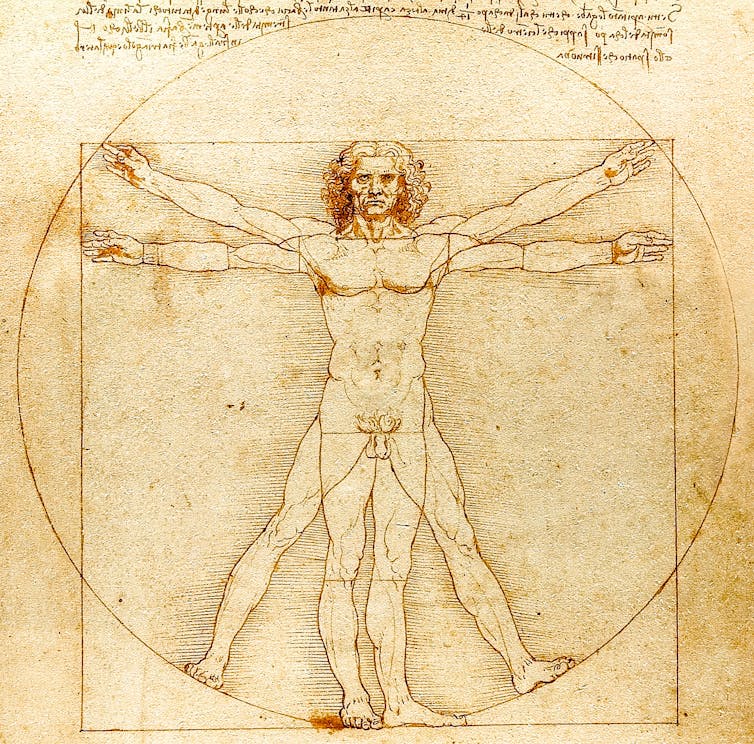
As nosotros've grown taller, we've become more gracile. Over the past 2 meg years, our skeletons became more lightly built as we relied less on brute force, and more than on tools and weapons. Equally farming forced u.s. to settle down, our lives became more sedentary, so our os density decreased. As nosotros spend more time behind desks, keyboards and steering wheels, these trends volition probable continue.
Humans have also reduced our muscles compared to other apes, specially in our upper bodies. That volition probably go along. Our ancestors had to slaughter antelopes and dig roots; later they tilled and reaped in the fields. Modern jobs increasingly require working with people, words and code - they take brains, non muscle. Even for manual laborers - farmers, fisherman, lumberjacks - machinery such as tractors, hydraulics and chainsaws now shoulder a lot of the work. As physical strength becomes less necessary, our muscles will keep shrinking.
Our jaws and teeth also got smaller. Early, establish-eating hominins had huge molars and mandibles for grinding fibrous vegetables. As we shifted to meat, and so started cooking food, jaws and teeth shrank. Modern processed food – craven nuggets, Big Macs, cookie dough water ice foam – needs fifty-fifty less chewing, then jaws will go on shrinking, and we'll likely lose our wisdom teeth.
Beauty
Afterwards people left Africa 100,000 years ago, humanity'due south far-flung tribes became isolated past deserts, oceans, mountains, glaciers and sheer distance. In various parts of the world, dissimilar selective pressures – different climates, lifestyles and beauty standards – caused our appearance to evolve in unlike ways. Tribes evolved distinctive skin color, eyes, hair and facial features.
With civilisation'due south rise and new technologies, these populations were linked again. Wars of conquest, empire edifice, colonisation and trade – including trade of other humans – all shifted populations, which interbred. Today, road, rail and aircraft link us too. Bushmen would walk xl miles to detect a partner; nosotros'll go iv,000 miles. We're increasingly one, worldwide population – freely mixing. That will create a earth of hybrids – low-cal brownish skinned, dark-haired, Afro-Euro-Australo-Americo-Asians, their skin colour and facial features tending toward a global boilerplate.
Sexual pick will farther accelerate the development of our appearance. With most forms of natural selection no longer operating, mate pick will play a larger role. Humans might become more bonny, just more uniform in appearance. Globalised media may too create more uniform standards of beauty, pushing all humans towards a unmarried ideal. Sex differences, however, could be exaggerated if the ideal is masculine-looking men and feminine-looking women.
Intelligence and personality
Terminal, our brains and minds, our near distinctively homo feature, will evolve, perhaps dramatically. Over the past vi million years, hominin brain size roughly tripled, suggesting pick for large brains driven by tool use, complex societies and linguistic communication. Information technology might seem inevitable that this trend volition continue, simply it probably won't.
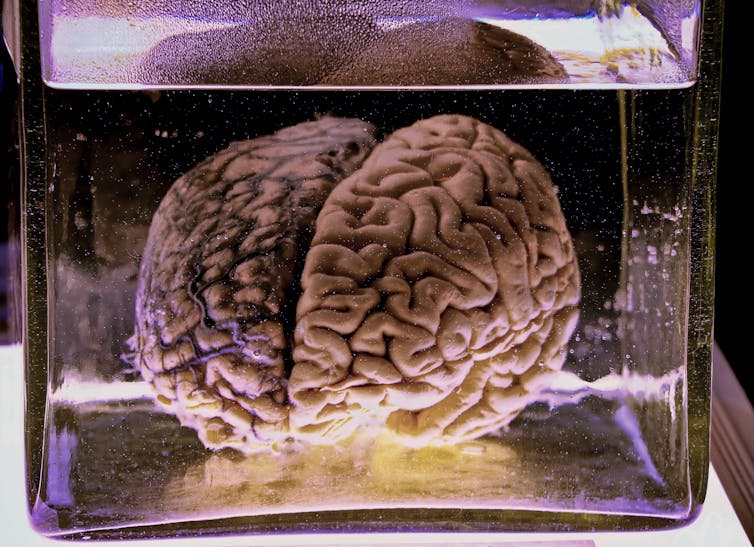
Instead, our brains are getting smaller. In Europe, brain size peaked 10,000—20,000 years ago, only earlier we invented farming. Then, brains got smaller. Modern humans take brains smaller than our ancient predecessors, or even medieval people. It's unclear why.
It could exist that fat and protein were deficient in one case nosotros shifted to farming, making information technology more than costly to grow and maintain big brains. Brains are also energetically expensive – they burn down around 20% of our daily calories. In agricultural societies with frequent famine, a big encephalon might exist a liability.
Maybe hunter-gatherer life was demanding in ways farming isn't. In civilisation, you lot don't need to outwit lions and antelopes, or memorise every fruit tree and watering hole inside ane,000 foursquare miles. Making and using bows and spears as well requires fine motor command, coordination, the power to track animals and trajectories — maybe the parts of our brains used for those things got smaller when we stopped hunting.
Or maybe living in a large society of specialists demands less brainpower than living in a tribe of generalists. Stone-age people mastered many skills – hunting, tracking, foraging for plants, making herbal medicines and poisons, crafting tools, waging war, making music and magic. Modern humans perform fewer, more specialised roles every bit function of vast social networks, exploiting division of labour. In a civilisation, nosotros specialise on a trade, then rely on others for everything else.
That existence said, brain size isn't everything: elephants and orcas have bigger brains than us, and Einstein's brain was smaller than boilerplate. Neanderthals had brains comparable to ours, but more of the brain was devoted to sight and command of the trunk, suggesting less capacity for things like linguistic communication and tool use. So how much the loss of encephalon mass affects overall intelligence is unclear. Peradventure we lost certain abilities, while enhancing others that are more relevant to modern life. It'due south possible that we've maintained processing power by having fewer, smaller neurons. Nevertheless, I worry well-nigh what that missing x% of my grey affair did.
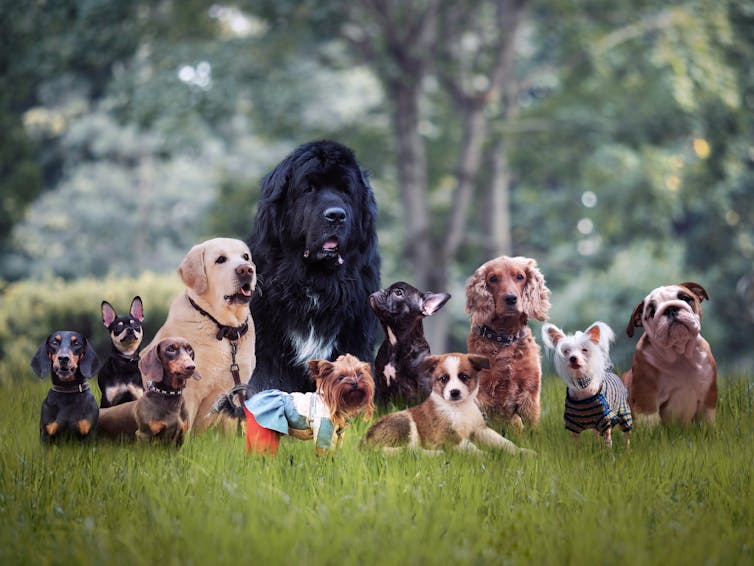
Curiously, domestic animals besides evolved smaller brains. Sheep lost 24% of their encephalon mass after domestication; for cows, it'south 26%; dogs, thirty%. This raises an unsettling possibility. Perhaps being more than willing to passively go with the flow (perhaps even thinking less), like a domesticated brute, has been bred into us, similar it was for them.
Our personalities must be evolving too. Hunter-gatherers' lives required aggression. They hunted large mammals, killed over partners and warred with neighbouring tribes. We get meat from a store, and plough to police and courts to settle disputes. If war hasn't disappeared, it now accounts for fewer deaths, relative to population, than at any time in history. Assailment, now a maladaptive trait, could exist bred out.
Changing social patterns will also alter personalities. Humans live in much larger groups than other apes, forming tribes of around one,000 in hunter-gatherers. But in today's world people living in vast cities of millions. In the past, our relationships were necessarily few, and often lifelong. Now nosotros inhabit seas of people, moving often for piece of work, and in the procedure forming thousands of relationships, many fleeting and, increasingly, virtual. This world will push button us to become more than approachable, open and tolerant. Yet navigating such vast social networks may too require we get more willing to adapt ourselves to them – to exist more conformist.
Not everyone is psychologically well-adapted to this existence. Our instincts, desires and fears are largely those of rock-age ancestors, who found meaning in hunting and foraging for their families, warring with their neighbours and praying to ancestor-spirits in the nighttime. Modern society meets our cloth needs well, but is less able to meet the psychological needs of our primitive caveman brains.
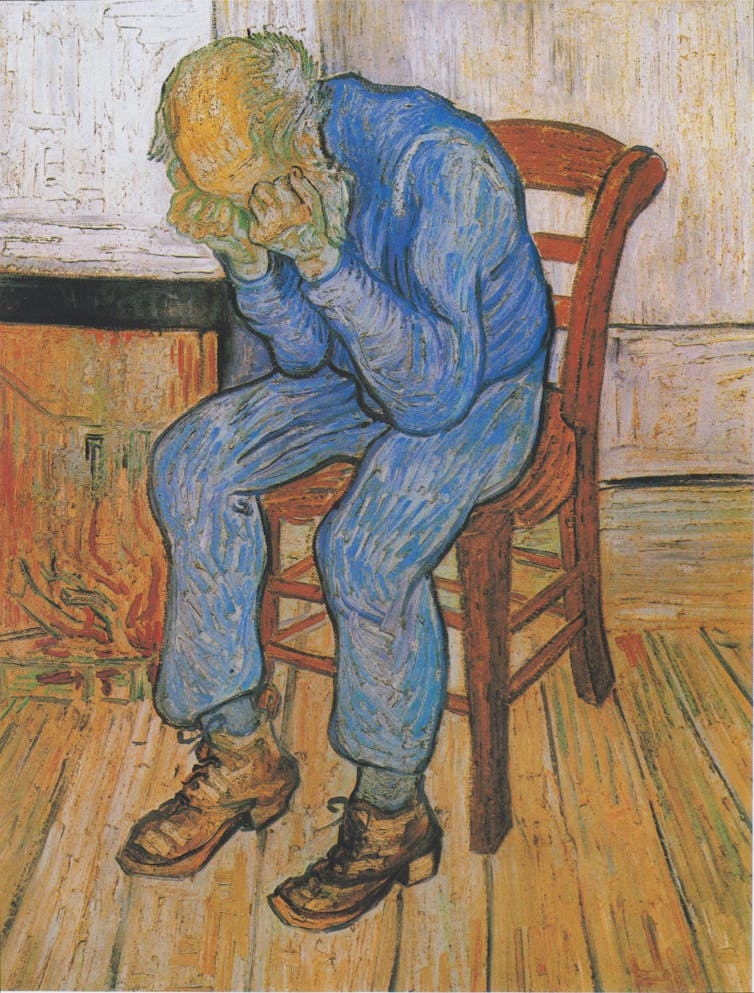
Perhaps because of this, increasing numbers of people suffer from psychological issues such as loneliness, anxiety and depression. Many turn to booze and other substances to cope. Selection confronting vulnerability to these conditions might better our mental health, and make united states of america happier as a species. But that could come at a price. Many groovy geniuses had their demons; leaders like Abraham Lincoln and Winston Churchill fought with depression, as did scientists such every bit Isaac Newton and Charles Darwin, and artists like Herman Melville and Emily Dickinson. Some, similar Virginia Woolf, Vincent Van Gogh and Kurt Cobain, took their own lives. Others - Billy Holliday, Jimi Hendrix and Jack Kerouac – were destroyed by substance abuse.
A disturbing idea is that troubled minds volition be removed from the gene puddle – but potentially at the cost of eliminating the sort of spark that created visionary leaders, great writers, artists and musicians. Hereafter humans might be better adjusted – but less fun to political party with and less likely to launch a scientific revolution — stable, happy and boring.
New species?
There were one time nine human species, at present it'southward only us. But could new human species evolve? For that to happen, we'd demand isolated populations bailiwick to distinct selective pressures. Altitude no longer isolates united states of america, simply reproductive isolation could theoretically be accomplished by selective mating. If people were culturally segregated – marrying based on faith, class, degree, or even politics – distinct populations, even species, might evolve.
In The Time Auto, sci-fi novelist H.M. Wells saw a future where class created distinct species. Upper classes evolved into the beautiful but useless Eloi, and the working classes become the ugly, subterranean Morlocks – who revolted and enslaved the Eloi.
In the by, religion and lifestyle take sometimes produced genetically distinct groups, as seen in for example Jewish and Gypsy populations. Today, politics too divides usa – could information technology divide u.s.a. genetically? Liberals now motility to exist near other liberals, and conservatives to be near conservatives; many on the left won't engagement Trump supporters and vice versa.
Could this create two species, with instinctively different views? Probably not. Yet, to the extent civilization divides u.s.a., it could drive evolution in unlike ways, in different people. If cultures become more diverse, this could maintain and increase human genetic diversity.
Strange New Possibilities
And then far, I've mostly taken a historical perspective, looking back. Simply in some means, the future might be radically unlike the past. Development itself has evolved.
One of the more extreme possibilities is directed development, where we actively command our species' evolution. We already breed ourselves when we cull partners with appearances and personalities we like. For thousands of years, hunter-gatherers arranged marriages, seeking practiced hunters for their daughters. Even where children chose partners, men were more often than not expected to seek approval of the bride's parents. Similar traditions survive elsewhere today. In other words, we brood our ain children.
And going forrard, we'll do this with far more than knowledge of what we're doing, and more command over the genes of our progeny. We can already screen ourselves and embryos for genetic diseases. We could potentially choose embryos for desirable genes, as we exercise with crops. Direct editing of the DNA of a man embryo has been proven to exist possible — but seems morally abhorrent, effectively turning children into subjects of medical experimentation. And yet, if such technologies were proven safety, I could imagine a hereafter where you lot'd exist a bad parent non to give your children the best genes possible.

Computers also provide an entirely new selective pressure. Every bit more than and more matches are made on smartphones, nosotros are delegating decisions about what the next generation looks similar to computer algorithms, who recommend our potential matches. Digital code now helps choose what genetic code passed on to future generations, just similar it shapes what you stream or purchase online. This might sound like dark science fiction, simply it's already happening. Our genes are being curated by estimator, just like our playlists. It's hard to know where this leads, simply I wonder if it'south entirely wise to plow over the future of our species to iPhones, the internet and the companies behind them.
Discussions of homo evolution are usually backward looking, as if the greatest triumphs and challenges were in the distant by. Merely as technology and culture enter a flow of accelerating change, our genes will too. Arguably, the almost interesting parts of evolution aren't life'south origins, dinosaurs, or Neanderthals, merely what's happening right at present, our nowadays – and our hereafter.
More Life'due south Large Questions:
-
Happiness: is contentment more important than purpose and goals?
-
Would we nonetheless see ourselves as 'human' if other hominin species hadn't gone extinct?
-
Death: can our final moment be euphoric?
-
How could the Big Bang arise from nada?
-
Love: is information technology merely a fleeting high fuelled by brain chemicals?
Source: https://theconversation.com/future-evolution-from-looks-to-brains-and-personality-how-will-humans-change-in-the-next-10-000-years-176997
0 Response to "If All Humans Died Would Humans Evolve Again"
Postar um comentário