Why Doesn't Baby Get Tangled in Umbilical Cord


An umbilical cord may become compressed or damaged before or during childbirth. Mutual signs of umbilical cord problems include an irregular fetal heartbeat and decreased or low fetal move. Umbilical string problems can be a serious threat to the child'due south health and should exist carefully monitored and treated equally necessary.
The information in this post was compiled from government, educational non-profit, and medical expert sources.
Keep reading to learn about the signs of umbilical cord problems.
The Umbilical Cord Delivers Oxygen to the Baby
Earlier exploring the common problems with umbilical cords, we should first examine why the umbilical cord is so important.
The umbilical cord connects the mother to the infant as the baby develops in the womb. The umbilical string starts at the mother'southward placenta and connects to an opening in the babe's stomach.
During pregnancy, the umbilical cord delivers vital nutrients and oxygen from the mother to the baby. The umbilical string has one vein and two arteries surrounded past a protective layer. The protective layer is made up of a substance chosen Wharton'south jelly and wrapped in a membrane called the amnion.
The vein delivers blood total of nutrients and oxygen to the baby, while the arteries remove deoxygenated blood and waste material from the infant back to the placenta.
Afterward the baby is born, the umbilical cord is clamped and cut. At that place are no nerves inside an umbilical string, so this is not painful for the baby or for the mother. Within a couple of weeks, the clamped stump of the umbilical cord will eventually fall off, leaving behind the baby'south belly push button.
In summary: if the proper function of the babe's umbilical cord is vital to evangelize nutrients and oxygen to the baby.
Most Common Umbilical Cord Problems
Here are some of the most common umbilical cord bug that can interfere with the health of the baby:
- Umbilical cord compression
- Nuchal cords
- True knots
- Umbilical cord prolapse
- Short umbilical cords
- Vasa previa
- Umbilical string infection
In the next sections, nosotros will learn about the signs of each problem and what each problem means for the baby.
Umbilical Cord Compression
One mutual umbilical cord trouble is due to compression. Compression occurs when pressure partially or completely stops the flow of blood through the umbilical string. Babies can survive short periods of umbilical cord compression, only if an adequate catamenia of claret to the baby is not re-established, the baby may suffer serious birth injuries. As nosotros covered in the previous sections, this condition is dangerous considering babies need nutrients and oxygen to remain healthy during development.
Signs of umbilical cord compression may include less action from the baby, observed as a decrease in move, or an irregular heart beat, which can be observed by fetal eye monitoring.
Common causes of umbilical cord compression include: nuchal cords, true knots, and umbilical cord prolapse.
Nuchal Cords
Nuchal cord is the medical term for when an umbilical cord becomes wrapped one time or more than times around the infant's neck within the womb. Nuchal cord with ane loop of cord around the baby's neck may occur in approximately 20% of deliveries.
Nuchal string is usually caused by the baby's movement through a loop of the umbilical cord. Nuchal cord may exist detectable by electronic fetal heart monitoring. Certain patterns of the baby's middle rate, like "variable decelerations" of the heart rate, are frequently associated with nuchal cord. Nuchal cord may sometimes be visualized on color Doppler ultrasound.
Nuchal cords are a surprisingly mutual condition, occurring in as many as 35% of pregnancies. A nuchal cord becomes unsafe when the cord wraps tightly around the baby'due south neck, often during labor and delivery, and the flow of blood to the babe is interrupted.
In a unsafe situation caused by a nuchal string, a c-department delivery may be necessary to quickly deliver the baby before the lack of blood flow causes the babe to suffer a permanent brain injury. Common injuries that tin be caused by nuchal cords include birth asphyxiation, HIE, and Cerebral Palsy.
If you believe that the umbilical cord was wrapped around your infant'due south neck and your babe has suffered an injury, we are happy to talk with y'all to make up one's mind whether or not the injury could have been prevented.
True Knots
True knots are the medical term for when the umbilical cord gets twisted like a rope into a knot. True knots tin class only past the babe's motility within the mother'southward womb. Other causes can include monoamniotic twins (when twins share the aforementioned amniotic sac), polyhydramnios (excessive amounts of amniotic fluid), overly long umbilical cords, smaller than normal fetuses, gestational diabetes, and amniocentesis (a process to test the amniotic fluid). Truthful knots too can course more than ofttimes in male fetuses or when the female parent has had several previous pregnancies.
If a baby'southward activeness decreases after 37 weeks, that is a mutual sign of a true knot. Medical professionals should remain alert for decreased activity and should test for umbilical string problems every bit needed.
Medical professionals can bank check for a reassuring heartbeat from the babe and monitor the baby'southward activity to determine whether further intervention is required. More on True & False Knots
Umbilical String Prolapse
A prolapse means that the umbilical cord has moved down the birth canal before or along side of the baby. Ideally, the umbilical string should follow the babe out through the birth canal. If the cord gets ahead of the baby or moves along side the baby, a dangerous state of affairs tin develop leading to birth asphyxia, HIE, and other birth injuries.
If a female parent or a medical professional person becomes aware of a possible cord prolapse, the medical professionals should take firsthand steps to monitor and intervene as necessary–particularly if the prolapse occurs inside the third trimester. By carefully monitoring the situation and by delivering the infant by c-section, potential serious injuries may be avoided.
In summary: umbilical cord compression can be caused by nuchal cords, true knots, and umbilical cord prolapse. In all of these circumstances, medical professionals must carefully monitor the baby's health. If necessary, the medical professionals should consider ordering an emergency c-section to preclude further injury.
Learn more nigh prolapsed umbilical string
Short Umbilical Cords
If the baby's umbilical cord is short the baby'south movements may stretch and tear either the umbilical cord or the female parent's placenta (known as placental abruption). Ideally, an umbilical cord should be long plenty for the baby to motion without stretching the string, but non so long every bit to hands get knotted or tangled.
If a short umbilical string causes placental abruption, the female parent may hemorrhage a lot of blood, which tin be harmful to both the baby and the mother. Medical professionals should exist prepared to perform a c-section or an operative delivery with forceps or a vacuum extractor if necessary (although forceps and vacuum extractor methods tin besides exist unsafe and should not exist attempted if the medical professional is not well trained and experienced with these methods).
Vasa Previa
Vasa (from the latin for vessels) previa (from the latin for before) is a condition where the fetal blood vessels move out of the umbilical cord and into the amniotic sac membranes across the birth canal. In this position, the vessels are at take chances for rupture during labor and delivery, which can lead to massive blood loss and permanent injury of the baby.
If vasa previa is detected, medical professionals should consider an early on c-section to prevent potential birth injuries. If the blood vessels are ruptured during commitment, a blood transfusion may be necessary immediately after birth.
Umbilical Cord Infection
When the fetal membranes go infected, that infection can spread to the umbilical cord, the placenta, the fetus, and the amniotic fluid. This is called an intra-amniotic infection, or an IAI.
An IAI or an infection of the umbilical cord is called funisitis. An infection of the umbilical cord can potentially lead to fetal inflammatory response syndrome, or FIRS, and tin cause pre-term birth, neonatal sepsis, periventricular leukomalacia, and Cerebral Palsy.
Antibiotics tin potentially forbid a serious birth injury from occurring.
Treatment for Umbilical String Based Injuries
As we've already discussed in this article, conscientious monitoring, an early c-section or operative delivery, along with blood transfusions are all potential treatment strategies to prevent injuries acquired past umbilical cord issues.
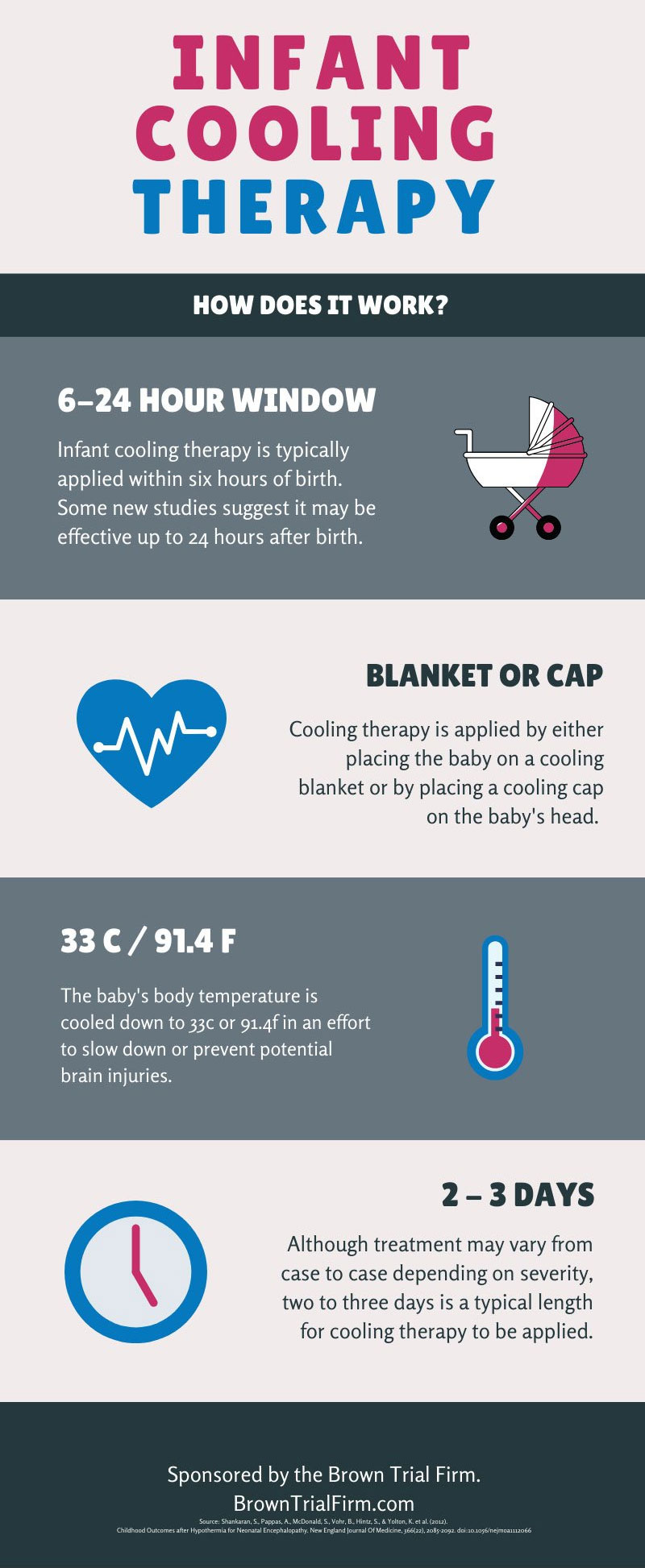
An additional handling strategy that becomes available once the child has been delivered is cooling therapy. Cooling therapy can be used shortly subsequently birth to try and deadening or cease permanent injuries acquired by lack of blood menstruum to the brain.
Use this infographic on your site
<a href="https://browntrialfirm.com/" target="blank"><img src="https://browntrialfirm.com/infographics/baby-cooling-therapy-btf.jpg" alt="Cooling Therapy Infographic" title="" style="width: 100%; max-width: 800px; display: cake; margin: 15px auto;" /></a>
Infant Cooling Therapy
How does it work?
half dozen-24 hour window
Babe cooling therapy is typically applied inside six hours of birth. Some new studies suggest it may be constructive upward to 24 hours after nascency.
Blanket or cap
Cooling therapy is applied by either placing the baby on a cooling blanket or by placing a cooling cap on the baby'south caput.
33 C / 91.4 F
The baby'south torso temperature is cooled down to 33c or 91.4f in an effort to slow down or prevent potential brain injuries.
2 – 3 days
Although treatment may vary from case to case depending on severity, ii to three days is a typical length for cooling therapy to be applied.
Sources:
What is the umbilical cord?. (2018). nhs.uk. Retrieved 17 Feb 2020, from https://www.nhs.uk/common-health-questions/pregnancy/what-is-the-umbilical-string/
Umbilical cord atmospheric condition. (2020). Marchofdimes.org. Retrieved 17 Feb 2020, from https://www.marchofdimes.org/complications/umbilical-cord-conditions.aspx
What happens if the umbilical string is around my infant's neck? | Your Pregnancy Matters | UT Southwestern Medical Eye. (2020). Utswmed.org. Retrieved 17 Feb 2020, from https://utswmed.org/medblog/nuchal-cord-during-pregnancy/
Contact a Cerebral Palsy and Birth Injury Chaser
Getting aid for a child with a nascency injury can brand a big divergence. Early intervention and early on treatment is often key to helping improve a child's wellbeing. You must deed apace.
If you have questions about whether your child's birth injury was acquired past a preventable medical error, so our attorneys at Brown Trial Firm may be able to assistance.
Case Review at No Toll or Obligation
If y'all would similar assist investigating your kid'south nascence injury, please contact us. Our birth injury attorneys will be happy to give you a free case evaluation. We tin can too point you to slap-up non-legal resources that can assist yous effigy out your next steps.
Many birth injuries that crusade cognitive palsy could have been prevented. Don't wait, go aid today. Telephone call +one (866) 393-2611, email u.s.a. at [e-mail protected], or use the alive chat push for 24/7 assistance.
Source: https://browntrialfirm.com/birth-injury-lawyer/umbilical-cord-injury/
0 Response to "Why Doesn't Baby Get Tangled in Umbilical Cord"
Postar um comentário